
?
What is ATS?
An Applicant Tracking System (ATS) is recruitment software used by companies and recruitment agencies to manage applications throughout the hiring process.
Modern ATS platforms can:
Store thousands of applications Search CVs using keywords Match candidates against job requirements Rank applicants based on relevance Parse information into searchable databases Help recruiters shortlist candidates faster Contrary to popular belief, most ATS platforms don't automatically reject applicants. Instead, they help recruiters prioritise the people who most closely match the role.
Think of it like Google.
If your CV doesn't contain the information a recruiter is searching for, your profile may never appear near the top of their search results.
For many job seekers, applying for a role feels like sending a CV into a black hole. You carefully tailor your application, click "Apply", and... nothing.
The truth is, in many cases, your CV hasn't been rejected by a recruiter—it simply hasn't been identified as a strong match by an Applicant Tracking System (ATS).
But here's the important part: ATS software isn't designed to reject people. It's designed to organise information.
The candidates who struggle aren't necessarily less qualified. They're often simply less measurable.

Kordian Pach
The Biggest Myth About ATS
Many candidates believe:
“The ATS rejected my CV.”
In reality, a better way to think about it is:
The ATS couldn’t confidently identify you as the right person.
That’s a huge difference.
Recruiters search their ATS databases using very specific criteria.
Examples include:
- Kitchen Designer
- AutoCAD
- Fusion 2020
- Project Management
- Sales
- Bathrooms
- SAP
- Manufacturing
- B2B Sales
- Marketing Automation
- Adobe Premiere Pro
If your CV never mentions these skills—even if you actually possess them—the system has nothing to match against.
The result? You’re invisible.
ATS Doesn’t Ignore Weak Candidates.
It Ignores Undefined Candidates.
This is perhaps the biggest shift in modern recruitment.
Recruiters aren’t looking for “good people.”
They’re looking for clearly defined professionals.
A vague CV like this:
“Worked within a sales environment helping customers and completing projects.”
tells an ATS almost nothing.
A stronger version would be:
“Kitchen Sales Designer specialising in German kitchens, CAD design, showroom sales, project management, quotation preparation and customer consultations.”
Now you’ve provided measurable information.
The ATS can recognise your expertise.
The recruiter can immediately understand your value.
Keywords Matter — But Context Matters More
Some candidates try to beat ATS by stuffing dozens of keywords into white text or hidden sections.
That may have worked years ago.
Today, it usually doesn’t.
Modern ATS software—and recruiters—look for context.
Instead of listing:
- Sales
- Design
- Customer Service
- AutoCAD
- Kitchens
Write naturally:
Designed bespoke kitchens using AutoCAD and Fusion software, managed projects from consultation through installation, consistently exceeding monthly sales targets while delivering exceptional customer service.
Now every important keyword appears naturally.
Every CV Should Be Written for One Job
One of the biggest mistakes candidates make is using one generic CV for every application.
ATS works through matching.
If you’re applying for:
- Marketing Executive
- Digital Marketing Manager
- AI Automation Specialist
- Content Creator
each role requires different language.
Although your experience may be identical, the wording should change to reflect the terminology used in each job advert.
Think of your CV as answering one question:
“Why am I the best fit for this specific position?”
Mirror the Language of the Job Advert
One of the simplest ways to improve ATS performance is to study the job description.
If it repeatedly mentions:
- CRM
- Lead Generation
- HubSpot
- SEO
- Campaign Management
those terms should naturally appear within your experience—if they’re genuine skills you’ve used.
Recruiters often search using exactly the same phrases used within the advert.
Matching that language improves your chances of appearing in their searches.
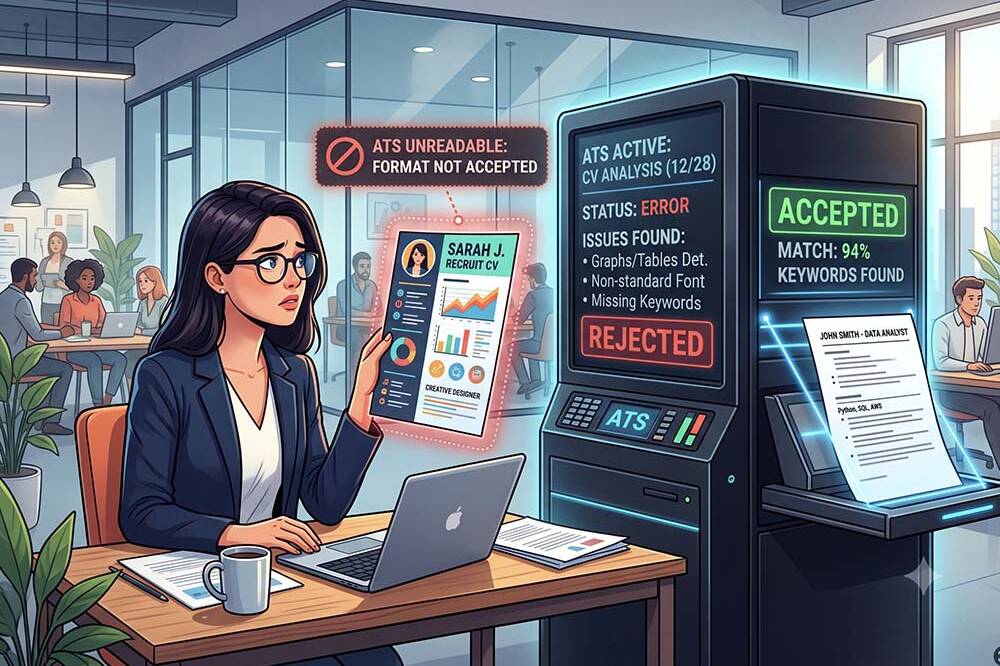
Make Your CV Easy for Software to Read
Fancy designs don’t impress ATS software.
In fact, they can make your CV harder to interpret.
Avoid:
- Tables for key information
- Text boxes
- Multiple columns
- Icons instead of words
- Graphics showing skills
- Images containing text
- Unusual fonts
Instead use:
- Clear section headings
- Standard fonts
- Simple bullet points
- Reverse chronological order
- Consistent formatting
- Plenty of white space
Remember:
Your first audience isn’t a recruiter.
It’s software.
Numbers Create Credibility
ATS systems can recognise measurable achievements.
Instead of writing:
Managed projects.
Write:
Managed over 120 residential kitchen projects annually with an average customer satisfaction rating above 95%.
Instead of:
Increased sales.
Write:
Increased showroom sales by 28% over 12 months.
Specific numbers make your achievements easier for both ATS systems and recruiters to understand.
Don’t Forget Your Cover Letter
Many candidates assume cover letters no longer matter.
In reality, they can strengthen your application when they’re tailored to the role.
A strong cover letter should reinforce:
- Your most relevant experience
- Key technical skills
- Industry knowledge
- Motivation for the role
It shouldn’t simply repeat your CV.
Instead, it should connect your experience directly to the employer’s requirements.
The Rise of AI in Recruitment
Today’s recruitment technology goes beyond traditional ATS software.
Many organisations now use AI-powered tools that can:
- Compare candidates against successful previous hires
- Identify transferable skills
- Extract information from CVs automatically
- Summarise candidate profiles
- Recommend suitable applicants to recruiters
The better structured your CV is, the more accurately these tools can understand your experience.
The Human Recruiter Still Makes the Final Decision
Despite advances in AI and ATS technology, recruitment remains a human process.
Technology helps recruiters manage hundreds—or sometimes thousands—of applications efficiently.
But it doesn’t replace professional judgement.
A well-written CV gets you noticed.
A great interview gets you hired.
Modern recruitment isn’t about tricking the ATS.
It’s about making your experience easy to understand.
Don’t think of ATS software as a gatekeeper trying to reject candidates.
Think of it as a search engine trying to identify the best match.
If your skills are clearly defined, your achievements are measurable, and your CV reflects the language of the role you’re applying for, you’ll dramatically improve your chances of appearing where recruiters are actually looking.
Because in today’s recruitment market, it’s not the strongest CV that wins—it’s the clearest one.